

Plenty of “essential website elements” lists read like a feature checklist for a demo — the things that look good when you’re signing off a project, not the things that make a site earn its keep once real traffic arrives. These ten are the ones that actually move the numbers. Get them right and the rest is detail.
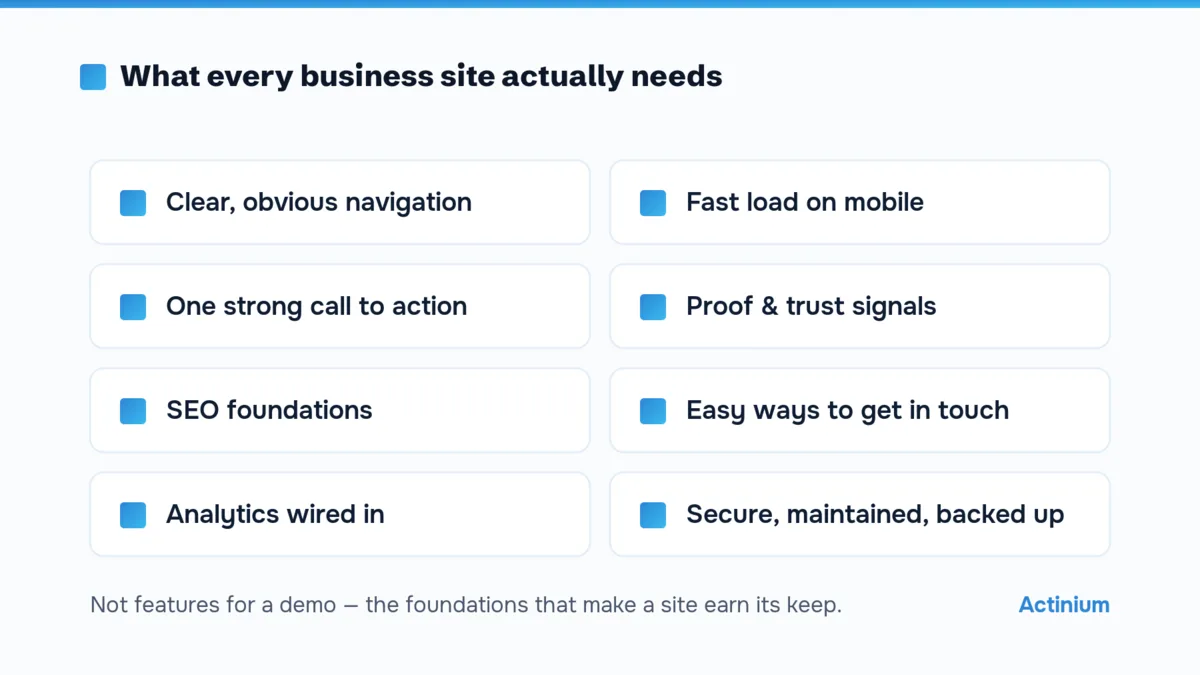
1. Clear, obvious navigation
A visitor should understand where to go within seconds. Plain labels, a logical structure, and the important pages no more than a click away. If people have to think about how to find something, most won’t — they’ll leave.
2. Fast load, especially on mobile
Speed is the first thing a visitor feels and the first thing Google measures. Oversized images, heavy page builders and render-blocking scripts cost you both rankings and conversions. A fast site beats a pretty-but-slow one almost every time.
3. One strong call to action
Every page should make the next step obvious — call, book, buy, enquire. Not five competing buttons; one clear action, given prominence and contrast. Confusion about what to do next is where conversions quietly die.
4. Proof and trust signals
Reviews, testimonials, recognisable client logos, real results. People decide with their gut and justify with proof — so put that proof where decisions get made, not buried on a separate page. It’s often the difference between a visitor and a customer.
5. A real “About” that builds credibility
Not a wall of corporate filler — a straight, human explanation of who you are, what you do and why you can be trusted with the job. It’s frequently the second page people visit, and it does a lot of the convincing.
6. Mobile-first, responsive design
Most of your traffic is on a phone, so the small screen is the starting point, not an afterthought. Layouts, tap targets and forms should be built for a thumb first, then expanded for desktop — never the other way around.
7. SEO foundations
Title tags, heading hierarchy, clean URLs, schema, internal links and crawlable pages. This is the structural work that decides whether you can rank at all. Done right, it pays off for years — on one project these foundations took average Google position to 6.9 with a 19% click-through rate.
8. Analytics wired in from day one
You can’t improve what you can’t see. Proper analytics shows where visitors come from, which pages perform and where people drop off — the feedback loop that turns guesses into decisions. Set it up at launch, not a year later.
9. Easy ways to get in touch
Phone, email, a short contact form, a map if location matters — visible and frictionless. Every extra field or hidden detail between an interested visitor and getting in touch is a chance to lose them.
10. Security and maintenance
HTTPS, current software, regular backups and a plan for updates. The unglamorous stuff that doesn’t show in a screenshot but protects the business when something goes wrong — which, eventually, it does.
The thread that ties them together
None of these are features you bolt on at the end. They’re foundations — which is why we treat a website as a product, not a one-off project: build on solid ground, measure what matters, and improve with evidence — the core of our web design and development. See the standard across our recent work, or get a free 48-hour audit that checks your current site against exactly this list.