

“We just use Instagram” is a perfectly good place to start a business — and a risky place to keep it. Social media is brilliant at reach: getting in front of new people, showing personality, building an audience. But reach isn’t the whole job. The moment someone is ready to trust you, compare you or buy from you, social runs out of road. That’s the work your website is built for.
It’s not a choice between the two. It’s understanding what each is actually for.
Rented reach vs. owned ground
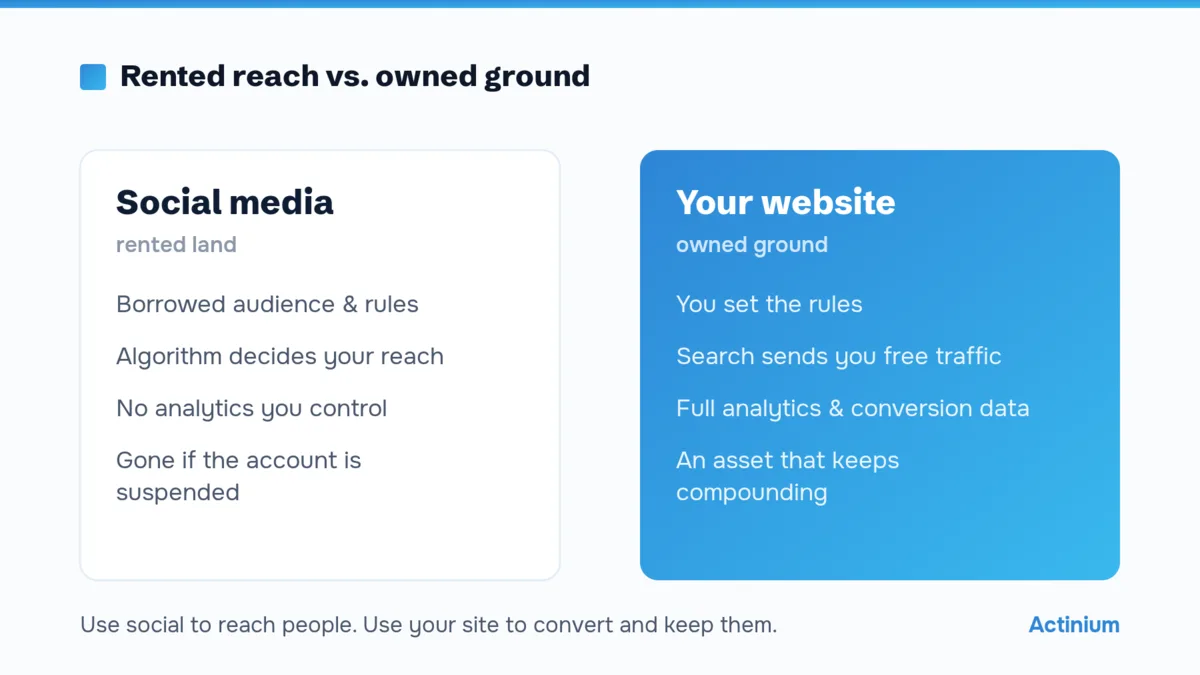
This is the distinction that matters most. Your social following lives on land you rent. The platform controls who sees your posts, changes the rules without warning, and can suspend an account and erase years of work overnight. Your website is ground you own — the audience, the data and the customer relationship are yours, and no algorithm sits between you and the people you’re trying to reach.
It’s where searchers find you
People who don’t already follow you find businesses by searching — and search sends traffic to websites, not social profiles. Get the foundations right and that traffic is both free and high-intent: someone searching for what you sell is closer to buying than someone scrolling a feed. On one e-commerce project, fixing structure and content took average Google position to 6.9 with a 19% click-through rate. A social account, however polished, can’t do that.
It’s where you control the experience
On social you get whatever layout the platform allows, in whatever order the feed decides. On your own site you design the whole journey: the path from first click to enquiry or checkout, the way products are sorted, the trust signals placed exactly where decisions get made. That control is the difference between hoping people convert and designing for it.
It’s where you actually learn what’s working
Social gives you vanity metrics — likes, follows, reach. Your website gives you the numbers that change decisions: where visitors come from, which pages pull their weight, where people drop off before they convert. That’s the feedback loop that lets you improve the site quarter after quarter instead of guessing.
Use both — for what each does best
Social is the top of the funnel: discovery, personality, staying in front of people. Your website is where that attention turns into customers and data you own. Point your channels at a hub built to convert, and the two compound instead of competing. That’s exactly how we build sites as products — see our recent work, or get a free 48-hour audit of the site your social traffic is currently landing on.