

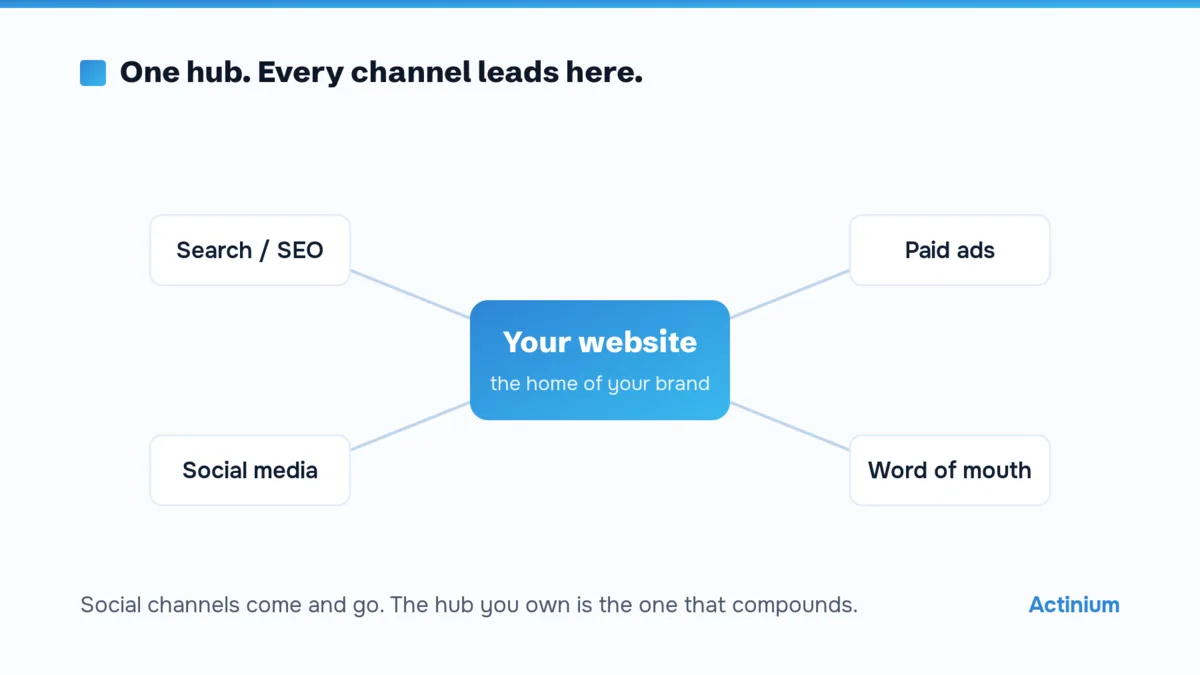
If your business runs fine on word of mouth and a busy Instagram, it’s fair to ask: do I really need a website? Short answer — yes, and not for the reasons people usually give. A good site isn’t a digital brochure you tick off a list. It’s the one piece of your online presence that you actually own, and the place every other channel should lead back to.
Here’s why that matters, and what separates a site that earns its keep from one that just exists.
It’s the only platform you own
Social accounts are rented ground. The platform decides who sees your posts, changes the rules whenever it likes, and can suspend an account overnight. Your website answers to no algorithm. The traffic, the data and the customer relationship are yours — and that’s an asset that compounds year after year instead of resetting with every feed change.
It’s where people decide whether to trust you
Before someone calls, books or buys, they look you up. No site — or a slow, dated one — plants a quiet doubt: is this business still going, and are they any good? A clear, fast website does the opposite. It’s where reviews, case studies and a straight explanation of what you do turn a curious visitor into a confident customer.
It’s how new customers find you in the first place
When someone searches “best [what you do] near me”, the businesses on page one win the work. That visibility comes from SEO foundations most sites never get right — and the gains are real. On one e-commerce build we took average Google position to 6.9 with a 19% click-through rate, simply by fixing structure, speed and content the right way. Social search can’t do that; people have to already know your name.
It works while you sleep
A good site answers questions, takes bookings, sells products and captures enquiries at 2am without you lifting a finger. Opening hours, pricing, FAQs, a contact form, a checkout — the routine stuff that eats your day gets handled automatically, so your time goes to the work only you can do.
What actually makes a website “good”
This is where most small-business sites fall down. Having a website isn’t the goal — having one that performs is. In practice that means it loads fast, reads clearly on a phone, ranks for the things people search, and makes the next step obvious — the baseline for our web design and development. We build sites as products, not one-off projects: launch a strong first version, then improve the parts the data says are holding you back.
If you already have a site and you’re not sure which camp it’s in, our free 48-hour audit will tell you plainly — what’s working, what’s costing you, and what’s worth fixing first. Or take a look at the sites we’ve built to see the standard we mean.