
Most business websites look fine and convert badly. They get signed off because they’re attractive and “done” — then they sit there, quietly failing to turn visitors into enquiries, bookings or sales. A website that converts is a different thing entirely: it’s built around a decision you want the visitor to make, and every part earns its place by helping them make it.
This is the long version of how we approach that at Actinium — a founder-led product studio with 9+ years and 50+ projects behind us. Whether you’re briefing an agency or building it yourself, here’s what actually separates a business website that converts from one that just exists.
Start with the job, not the homepage
The biggest mistake happens before a single pixel is designed: starting with “what should the site look like?” instead of “what is this site for?” A high-converting site has a clear primary job — book a consultation, request a quote, buy a product, start a trial — and a couple of supporting ones. Everything else is noise.
Get specific. Who is the visitor, what are they trying to do, and what’s the one action that’s worth most to your business? When you can answer that in a sentence, the design decisions get easier and the arguments about colours and sliders mostly disappear. The job comes first; the layout serves it.
The foundations that decide everything
Before design and copy, four foundations determine whether any of it can work. Skip them and you’re decorating a house with no plumbing.
- Speed. A fast site outsells a pretty one. Visitors feel the first second, and Google measures it. Oversized images, heavy page builders and render-blocking scripts cost you both rankings and conversions.
- Mobile-first. Most of your traffic is on a phone, so the small screen is the starting point, not an afterthought squeezed down from desktop.
- SEO structure. Title tags, heading hierarchy, clean URLs, schema and internal links decide whether you can be found at all. On one e-commerce build, getting these right took average Google position to 6.9 with a 19% click-through rate — traffic that’s both free and high-intent.
- Analytics from day one. You can’t improve what you can’t see. Wire in proper analytics at launch so you know where visitors come from and where they drop off.
If you already have a site, these four are exactly what our free 48-hour audit checks first — and a deeper version of the essential elements every business website needs.
Design every page around one decision
Conversion is a design problem before it’s a copy problem. Each page should guide the eye to a single, obvious next step. That means a clear visual hierarchy — a confident headline, generous whitespace, and one primary call to action that stands out from everything around it. When a page offers five equal choices, most people choose none.
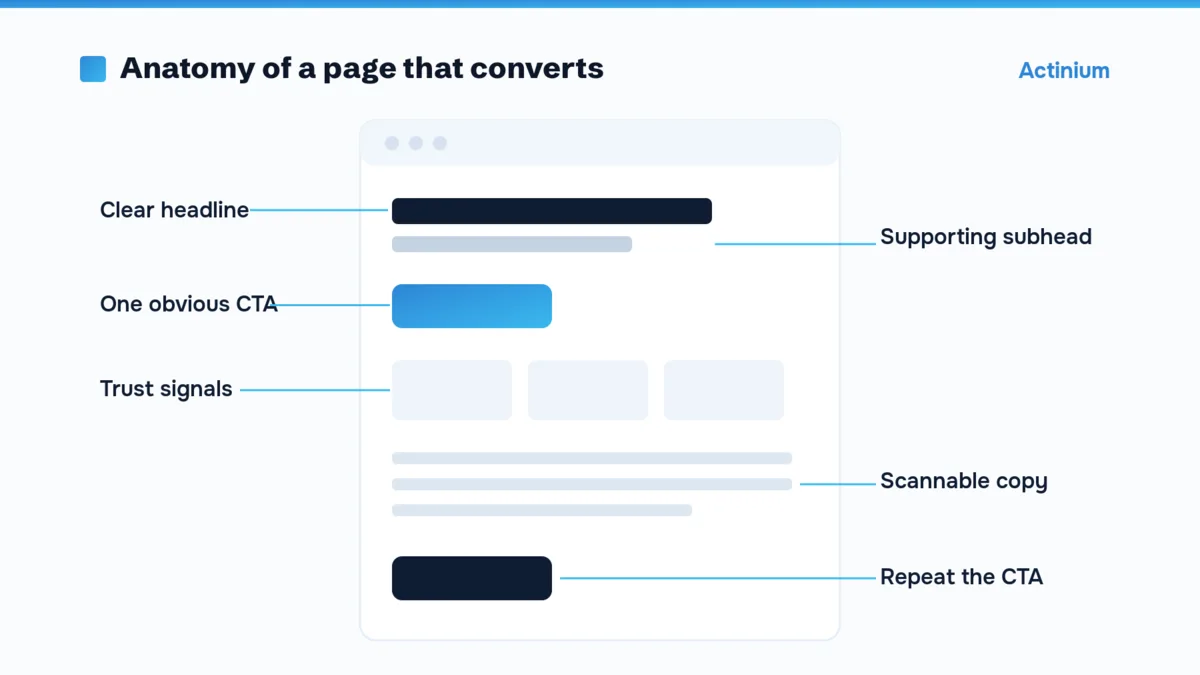
The pattern above holds up across almost every high-converting page: a headline that names the outcome, a subhead that adds the detail, one prominent CTA, trust signals placed right where doubt creeps in, scannable copy rather than dense paragraphs, and the same call to action repeated once the visitor has read enough to act. None of it is decoration — every element is doing a job. The design principles that actually last all serve this same goal.
Write copy that sells, not copy that describes
Most website copy describes the business. Converting copy speaks to the visitor’s problem and the outcome they want. The shift is simple but ruthless: lead with what the reader gets, not with how clever you are. “We build custom CV-management systems” is a description. “Hire faster with a recruitment system built around how your team actually works” is a benefit — and it’s the kind of framing that turned a $15,000 custom build for one client into a clear, sellable proposition.
Practical rules: one idea per section, short sentences, concrete specifics over vague adjectives, and a call to action that tells the reader exactly what happens next. Read every line and ask “so what?” — if there’s no answer, cut it.
Build trust where the decision happens
People decide with their gut and justify with proof. Reviews, testimonials, recognisable results and clear guarantees do the heavy lifting — but only if they’re placed where the decision is made, not buried on a separate page. A testimonial next to the pricing, a result stat beside the CTA, a logo row under the headline: that’s proof working at the moment of doubt. Scattered trust signals are wasted; positioned ones convert.
Own your platform — don’t build on rented land
A converting website is an asset you own outright. Social platforms are rented ground: the algorithm decides your reach, the rules change without warning, and an account can vanish overnight. Your site answers to no feed — the traffic, the data and the customer relationship are yours, and they compound year after year. Use social for reach, but send that attention to a hub built to convert. We dig into this trade-off in your website vs. social media.
Treat it as a product, not a project
Here’s the mindset that ties everything together. A website isn’t a project that ends on launch day — it’s a product that lives. The first version is your best informed guess. The real gains come from watching how people actually use it and improving the parts that move the numbers.
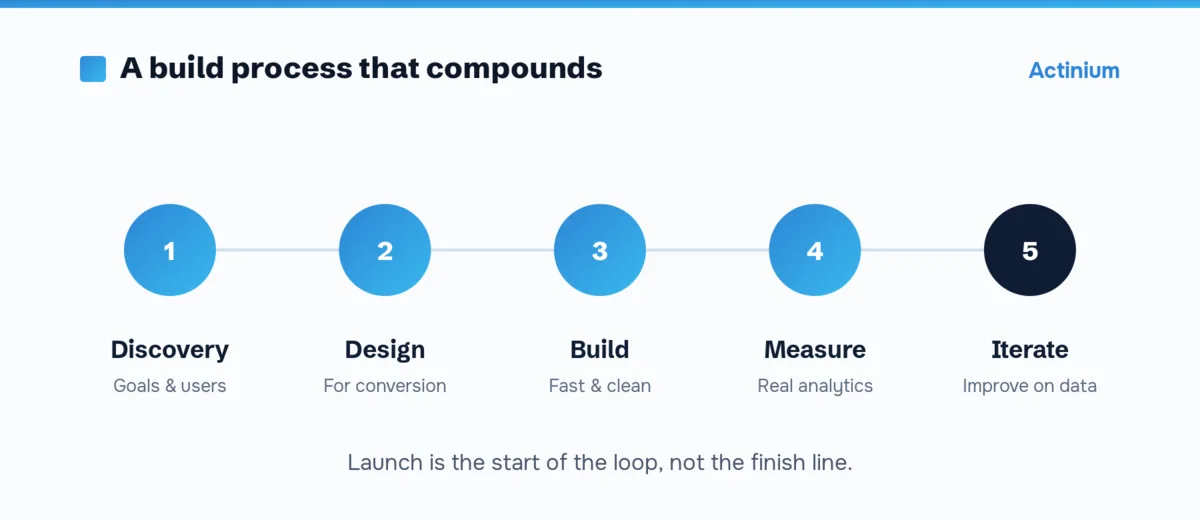
That’s why we run a simple, repeatable loop: discovery (goals and users), design (for conversion, not just looks), build (fast and clean), measure (real analytics), then iterate (improve on evidence). Launch is the start of that loop, not the finish line — which is exactly why a site built this way gets better every quarter instead of decaying from day one.
Common mistakes that quietly kill conversion
- Too many calls to action. Competing buttons split attention. One primary action per page wins.
- Slow, image-heavy pages. Every extra second of load costs conversions before anyone reads a word.
- Talking about yourself. Copy that lists features instead of answering “what’s in it for me?”
- Forms that ask too much. Every unnecessary field is a reason to abandon. Ask only for what you need now.
- No proof near the decision. Trust signals hidden on an “About” page instead of placed beside the CTA.
- Launch and leave. Treating the site as finished, so it never improves on what the data is telling you.
Frequently asked questions
How long does it take to build a business website that converts?
A focused, conversion-led site typically takes a few weeks from discovery to launch, depending on scope and how much content is ready. But the honest answer is that it’s never truly “finished” — the strongest results come from launching a solid first version and improving it with real data over the following months.
Do I need a custom site or is a template enough?
A good template can convert perfectly well for a simple business. You outgrow templates when your offer is unusual, when performance and SEO need to be tightly controlled, or when you want the site to do something specific — a booking flow, a product configurator, a custom system. That’s where a custom build earns its keep.
How do I know if my current website is converting?
Look at the numbers, not the looks: how many visitors take the action that matters, where they drop off, and how fast the key pages load. If you don’t have analytics that answer those questions, that’s the first thing to fix. A free 48-hour audit will give you an honest read.
What matters most for SEO on a business website?
The structural foundations: fast load, clean heading hierarchy, crawlable pages, internal links and schema — then genuinely useful content. Get the foundations right before chasing keywords; it’s what took one of our projects to an average position of 6.9 with a 19% click-through rate.
Where to start
You don’t need to do everything at once. Start with the job the site is for, fix the four foundations, and design each key page around one decision — then measure and improve. If you’d rather have it built right the first time, see the work we’ve shipped or explore how we can help. And if you just want an honest read on the site you have today, send us your URL for a free 48-hour audit — no call, no pitch deck, genuinely free.